How to Choose the Right Well Pressure Tank for Your New Jersey Home
Your well pressure tank is the unsung hero of your water system. Most homeowners never think about it until it fails. After 115 years of installing and replacing thousands of pressure tanks across South Jersey and Central Jersey, we can tell you that choosing the right tank is one of the most important decisions you can make for your well system.
An improperly sized tank will destroy your well pump years earlier than expected. A $1,500–$3,000 pump that could last 10–15+ years might fail in 5–7 years simply because the tank was too small. This guide covers everything you need to know: tank types, sizing, drawdown capacity, and why the brands we install make a real difference.
🎯 Key Takeaways
- Tank sizing is critical: An undersized tank causes short cycling, which can cut your pump's lifespan by years.
- Drawdown ≠ Total volume: A 44-gallon tank only provides about 13 gallons of usable water at 40/60 PSI operating pressure.
- Match pump output: Tank drawdown should equal or exceed your pump's GPM rating.
- Quality matters: High-quality tanks like Well-Rite last 10–15+ years vs. big-box brands that average just 5–7 years.
- Bigger is better: You cannot oversize a pressure tank. Larger tanks extend the life of your entire well system.
In This Guide
1. Why Your Well Tank Choice Matters More Than You Think
Here's why tank selection is so consequential: when a tank is undersized, the pump cycles on and off constantly, overheats, and burns out prematurely. A pump replacement that could have lasted 10–15+ years might fail in 5–7 years simply because the supporting tank was the wrong size.
The cost difference is dramatic. An undersized tank doesn't just shorten pump life;it compounds over the life of your entire system, leading to more frequent service calls, more emergency repairs, and days without water. We break this down with real numbers in the pump protection section below.
2. What Is a Well Pressure Tank and How Does It Work?
A well pressure tank is a sealed storage tank that maintains water pressure in your home and protects your pump from excessive cycling. Without one, your pump would turn on and off every time you opened a faucet, causing the pump to burn out in a matter of months.
The Basic Function
The tank stores pressurized water using a compressed air cushion separated by a rubber bladder (similar to a balloon). When you turn on a faucet, the compressed air pushes water out of the tank and through your plumbing. As water leaves, pressure drops. When pressure reaches the “cut-in” point (typically 30 or 40 PSI), the pump kicks on. The pump runs until the tank refills to the “cut-out” pressure (typically 50 or 60 PSI), then shuts off.
This cycle should occur only a few times per hour under normal use. If it happens every few seconds, you most likely have a problem. Such as an undersized tank, a waterlogged tank, or a leak.
Why Every Well System Needs One
Pressure tanks serve three critical functions:
- Pump protection: Minimizes on/off cycling that generates damaging motor heat during startup
- Consistent pressure: Maintains steady flow to fixtures throughout your home
- Water reserve: Provides stored water even if the pump momentarily can't keep up with demand
Without a pressure tank, a typical well pump would start and stop 300+ times per day. With a properly sized tank, it might cycle just 50–100 times. That difference adds years to your pump's lifespan.
3. Types of Well Pressure Tanks—and Which One Is Right for You
Not all pressure tanks are created equal. There are three main types, but only two are worth considering for a modern well system.
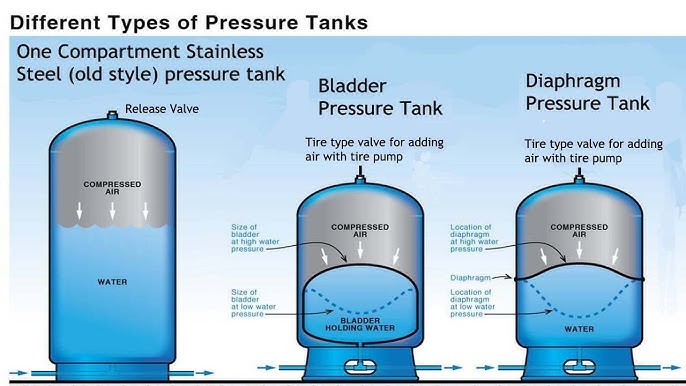
This is an example of how a steel bladder pressure tank draws down compared to an old-school steel non-bladder tank.
1. Steel Bladder Tanks (Industry Standard)
Bladder tanks such as Well-Rite and PJR use a rubber bladder inside a steel tank to separate air from water. The bladder flexes as water enters and exits, maintaining the air charge and preventing waterlogging.
Pros:
- Virtually maintenance-free
- Lifespan of 10–15+ years with quality brands
- Consistent pressure delivery
Cons:
- Bladders are not replaceable
- Can corrode in highly corrosive environments
Best for: Considered the gold standard—used in 90% of residential well systems in New Jersey.
2. Fiberglass / Composite Tanks
Flex-Light fiberglass tanks function like bladder tanks but use a fiberglass shell instead of steel. This unique construction allows them to be installed in ways steel tanks cannot—including burial underground or exposure to outdoor elements and corrosive environments.
Pros:
- Can be buried underground (steel tanks cannot)
- Suitable for outdoor locations or harsh/corrosive environments
- Weighs about half as much as steel (easier installation)
- Same lifespan as quality steel bladder tanks
- Virtually maintenance-free
Cons:
- Higher initial cost than steel tanks
- May need to be ordered (not always in stock)
Best for: Underground installations, outdoor locations, corrosive environments, and anywhere you need installation flexibility that steel can't provide.
3. Air-Over-Water Tanks (Obsolete—Don't Buy These)
These are the old-style galvanized steel tanks where air sits directly on top of water. Over time, water absorbs the air, the tank becomes waterlogged, and you have to manually add air back in.
Why we don't install them: Constant waterlogging problems, required quarterly or bi-annual maintenance, outdated technology with reliability issues, and poor efficiency. They are no longer manufactured for residential use. If you have one of these (installed 20+ years ago), it's time to upgrade. The improved performance and pump longevity will pay for itself.
4. Understanding Tank Drawdown: The Most Important Number
This is where most homeowners get confused. When someone says “I have a 44-gallon tank,” they're referring to the total volume—not the usable volume. The usable water is called drawdown, and it's always much smaller than the tank's total capacity.
What Is Drawdown?
Drawdown is the volume of water your tank actually delivers between pump cycles. It's the difference between the water in the tank at cut-out pressure (pump off) and cut-in pressure (pump on). At a 30/50 PSI pressure switch setting, a 44-gallon tank provides about 13 gallons of drawdown—the rest is taken up by the air bladder and compressed air cushion.
Drawdown at Different Pressure Settings
Your pressure switch setting directly affects how much drawdown you get from any given tank size. Higher pressure settings yield less usable water from the same tank. Here's a comparison for a 44-gallon tank:
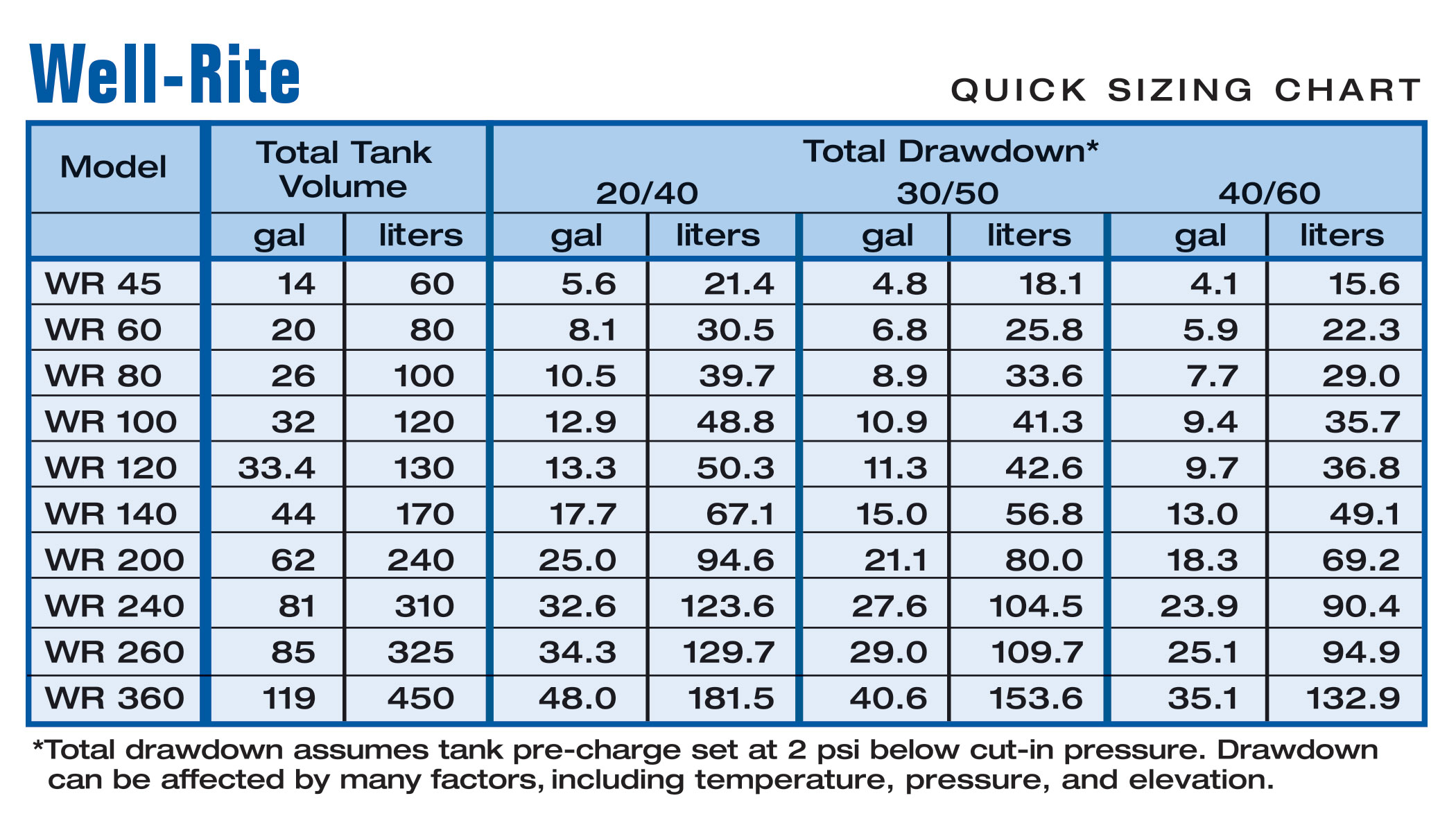
Drawdown varies significantly based on your pressure switch setting—always size your tank based on drawdown, not total volume
| Pressure Setting | Total Volume | Drawdown Capacity | Usable % |
|---|---|---|---|
| 20/40 PSI | 44 gallons | 17.7 gallons | 40% |
| 30/50 PSI | 44 gallons | 15 gallons | 34% |
| 40/60 PSI | 44 gallons | 13 gallons | 29.5% |
The Golden Rule: When in Doubt, Go Bigger
You cannot oversize a pressure tank. A larger tank means fewer pump cycles, longer pump life, more consistent water pressure, and higher resale value. The only downsides are higher upfront cost (usually $200–$500 more) and the space required. If you have the room and budget, always go one size up from the minimum—or consider a VFD with a smaller tank.
5. How Proper Sizing Protects Your Pump
The Short Cycling Problem
Short cycling is when your pump turns on and off every 1–30 seconds instead of running for 1–2 minutes per cycle. It is caused by an undersized tank, a waterlogged tank, or a plumbing leak—and it is the #1 killer of well pumps.
- Excessive heat buildup: Pump motors generate the most heat during startup, drawing 3–5 times the normal running current (typically 30–40 amps). Short cycling means the motor never has time to cool between starts.
- Motor winding damage: Constant heat degrades the insulation on motor windings until they short out and the pump fails.
- Mechanical wear: Starting and stopping stresses the pump's impellers, bearings, and seals, accelerating wear.
- Electrical stress: High inrush current can damage internal components and trip your breaker repeatedly.
The Real Cost of an Undersized Tank
Scenario 1: Properly Sized 62-Gallon Tank (15 GPM Pump)
- Tank cost: $2,000–$2,300 • Tank lifespan: 10–15+ years
- Total tank replacements over 30 years: 1–2 ($2,000–$4,600)
- Pump cycles: 50–80 times per day • Pump lifespan: 10–15+ years
- Total pump replacements over 30 years: 1–2 ($1,700–$4,000)
- 30-year total cost: $3,700–$8,600
Scenario 2: Undersized 20-Gallon Tank
- Tank cost: $1,200–$1,500 • Tank lifespan: 6–8 years
- Total tank replacements over 30 years: 3–4 ($3,600–$6,000)
- Pump cycles: 200–300 times per day • Pump lifespan: 6–8 years
- Total pump replacements over 30 years: 4–5 ($6,800–$15,000)
- 30-year total cost: $10,400–$21,000
The “cheaper” tank costs you an extra $6,000–$12,400 on average over the life of your well system—not counting inconvenience, emergency service calls, and days without water.
Pump Runtime Sweet Spot
- Under 30 seconds: Not enough cooling time—excessive cycling and heat damage
- 1–2 minutes: Optimal—proper cooling, minimal cycling, maximum lifespan
- Over 3–4 minutes: Usually fine, but may indicate well recovery or pump issues
If you time your pump and it runs less than 1 minute per cycle, your tank is undersized or waterlogged.
What We Don't Install (And Why)
You'll find cheaper tanks at big-box stores for $500–$900. We don't install them. Thin bladders that fail in 5–7 years, thin steel shells, inconsistent quality control, and poor warranty support mean that a $600 tank replaced every 6 years costs far more than a properly sized $1,200 tank lasting 15+ years. When we install a tank, it carries a 5-year warranty and is built to last 10–15+ years.
6. Signs Your Pressure Tank Needs Replacement
1. Rapid Pump Cycling (Short Cycling)
If your pump turns on and off every few seconds instead of running 1–2 minutes, you have a waterlogged tank, a failed bladder, or a leak.
How to test: Turn on a faucet and watch how long the pump runs before it stops (once the pump starts, close the main house valve to see the true tank drawdown). Time it. If it's less than 40 seconds, there's a problem.
2. Waterlogged Tank
The most common failure mode for bladder tanks. The bladder ruptures, water fills the tank, and you lose all air cushion.
How to test:
- Turn off pump power and shut off the main valve to the house
- Drain the tank completely
- Press the Schrader valve (like a tire valve) on top of the tank—if water sprays out instead of air, the bladder has failed
- Tap the tank—if it sounds completely solid, the bladder has failed
- Move the tank—if you hear water sloshing, the bladder has failed
3. Leak Somewhere in the Well System
Common in older systems or improperly installed new systems. Easy to diagnose:
How to test:
- Let the tank build to maximum pressure
- Close the valve going into the house
- Watch the gauge for at least 1 minute—if it drops more than 2–4 PSI, you likely have a leak outside or down the well
4. Inconsistent Water Pressure
Pressure that surges and drops, or faucets that sputter and spit air, often indicates a partially failed bladder, incorrect air charge, or a low-producing well. Multiple causes are possible—a professional diagnosis is recommended.
5. Visible Damage or Leaks
Check your tank regularly for visible deterioration on the exterior, water pooling around the base, leaks from the shell or connections, or a bulging/deformed tank body. If you see any of these, don't wait for catastrophic failure—replacement is needed.
6. Tank Age
- Cheap big-box tanks: 5–7 years
- Quality steel bladder tanks (Well-Rite, PJR): 10–15+ years
If your tank is over 20 years old and you're experiencing any pressure issues, proactive replacement is the smart move.
7. Professional Installation: Why DIY Often Isn't Worth It
Replacing a pressure tank isn't rocket science, but it's not as simple as swapping one for another. Professional installation ensures your tank is correctly sized, safely installed, properly set up to protect your pump, and that the rest of the system is in good working order.
What Our Installation Includes
When Robbins Water Service installs a pressure tank, here's what we do:
- Proper sizing verification based on your pump's actual GPM
- Pre-charge pressure adjustment to match your switch setting
- Pressure switch inspection and contact cleaning or replacement
- Piping and fitting integrity check
- Pump specs and performance testing
- Full system function testing before we leave
Common DIY Mistakes That Cost Money
We're often called to fix botched DIY tank replacements. The most common issues we see:
- Wrong size tank: Homeowner replaces a 44-gallon tank with another 44-gallon tank, not realizing the original was already undersized
- Incorrect pre-charge: Tank shipped at 38 PSI but the system runs at 30/50—causing immediate short cycling
- No pressure switch inspection: The old switch has burned contacts and doesn't maintain proper pressure even with a new tank
- Poor piping connections: Leaks develop over time from improper thread sealing
Professional installation costs $1,100–$2,200 depending on tank size and complexity. Compared to the $1,600–$3,000 cost of premature pump failure (which often occurs multiple times once short cycling begins), it is a wise investment.
Call us if:
- You're not sure what size tank you need
- Your well system includes water treatment, multiple zones, or irrigation
- The tank is in a difficult location (crawlspace, small basement, outdoor pit)
- You're experiencing ongoing pressure problems or frequent pump cycling
8. Frequently Asked Questions About Well Pressure Tanks
How do I know what size well tank I need?
Well tank size depends on your pump's flow rate (GPM). The tank's drawdown capacity should equal or exceed your pump's output in one minute. For example, a 10 GPM pump requires a tank with at least 10 gallons of drawdown, which equals a 44-gallon tank at 40/60 PSI. Always base sizing on drawdown, not total tank volume.
How do Variable Frequency Drives change pump-to-tank dynamics?
When using a VFD (Variable Frequency Drive), tank drawdown size matters much less. A VFD allows soft starting of the pump, ramping up gradually and drawing far less inrush current at startup. This means the pump doesn't need a full minute of runtime for heat dissipation, allowing a much smaller tank to be paired with high-horsepower pumps.
What is tank drawdown, and why does it matter?
Drawdown is the usable water your tank delivers between pump cycles—not the same as total tank volume. A 44-gallon tank only provides about 13 gallons of drawdown at 40/60 PSI. Adequate drawdown prevents short cycling, protecting your pump motor and extending pump life from 6–8 years to 10–15+ years.
How do I know if my pressure tank is waterlogged?
Signs include: pump cycling every 5–20 seconds, surging and dropping water pressure, a heavy feel when the tank is empty, water sloshing when you move the tank, or a solid sound when you tap it at the middle or top.
Can I install a pressure tank myself?
While DIY is possible, professional installation ensures proper sizing, correct pre-charge, and full system testing. Common DIY mistakes include wrong tank size, incorrect air pressure, and poor piping connections. Professional installation costs $1,000–$2,300 but prevents costly pump failures down the road.
What brands of well tanks does Robbins Water Service install?
We exclusively install Well-Rite (WR), PJR, and FL fiberglass tanks. These brands offer superior bladder quality, a 10–15+ year lifespan (vs. 5–7 years for cheap tanks), and better corrosion resistance.
How long does a well pressure tank last?
Cheap big-box tanks average 5–7 years. Quality steel bladder tanks like Well-Rite and PJR last 10–15+ years. Proper sizing and installation also significantly extend tank lifespan.
Should I replace my tank if it's still working?
If your tank is over 15 years old and you're experiencing pressure issues or pump problems, proactive replacement is the smart choice. Waiting for complete failure means emergency service calls, hours or days without water, and possible pump damage from short cycling. A planned replacement is always cheaper than an emergency one.
What's the difference between bladder tanks and diaphragm tanks?
Both separate air and water to prevent waterlogging. Bladder tanks use a balloon-like bladder that expands and contracts; diaphragm tanks use a flat rubber disc. Bladder tanks (our preference) typically offer greater drawdown capacity. Both are vastly superior to old air-over-water tanks.
Need a New Well Tank or Pressure System Evaluation?
Our licensed master well drillers can assess your current tank, calculate the proper size for your home, and install a quality tank that will protect your pump for decades.
Phone: 609-268-2040
Location: 146 Stokes Road, Shamong, NJ 08088
Serving Medford, Shamong, Tabernacle, Hammonton, Medford Lakes, Southampton, Chatsworth, and all of South and Central Jersey.
About Robbins Water Service
Family-owned and operated since 1910, Robbins Water Service holds New Jersey's highest well drilling license category (Master Well Driller). We specialize in residential and commercial well drilling, geothermal systems, well and pump repair, and water treatment throughout all of South and Central New Jersey. We've installed thousands of pressure tanks across Burlington, Atlantic, and Gloucester counties—and we exclusively install premium brands because we've seen firsthand how quality equipment saves our customers money over the long term.